Sign In / Create Account
Is ESA Registration a Scam? Here's What's Real and What's Not
Yes, ESA registration is a scam. No official ESA registry exists at the federal or state level, and no law requires you to register an emotional support animal. Vests, ID cards, certificates, and registration numbers carry zero legal weight.

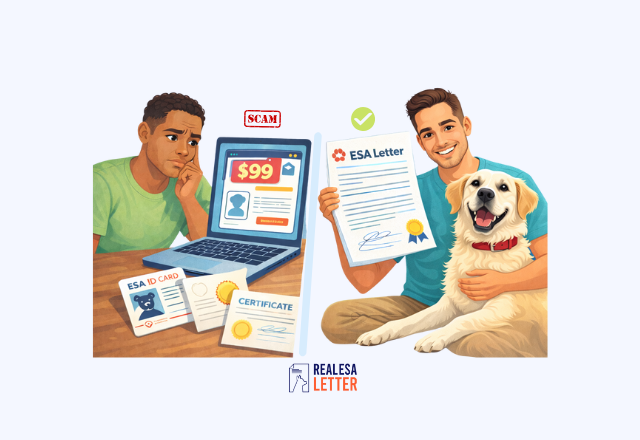
The only document that protects you is an ESA letter from a licensed mental health professional.
Let’s take a closer look at what’s fake, what’s legitimate, and the smart steps you can take to avoid ESA registration scams.
Key Takeaways
Yes It Is a Scam: No federal or state ESA registry exists. No law requires registration.
Merchandise Not Rights: Vests and ID cards and framed certificates create zero legal protection.
How the Scam Runs: An official-looking site claims registration is required. A five-minute quiz follows. You pay $49 to $99 and get an instant PDF.
It Fails at the Landlord's Office: A registration number verifies nowhere. There is no license to look up.
Real Letters Cost More: Expect $100 to $200 because a clinician spends real time on your case.
Is ESA registration legit?
No, ESA registration is not legit, and it helps to know why the myth spreads. Websites advertise “official ESA registration,” “national ESA IDs,” and “lifetime certificates” because confusion is profitable. Federal housing law never mentions a registry, a certificate, or a database.
Let’s explore the three things that actually decide whether your emotional support animal is protected.
The only legal document
Only one document carries legal weight: an ESA letter written and signed by a licensed mental health professional (LMHP) who is licensed in your state. The Fair Housing Act recognizes that letter, and nothing else does the job.
How to spot a fake website
A legitimate service always requires a real evaluation, usually a live telehealth or in-person consultation, before it issues a letter. Any site that hands you instant approval after a quick quiz is selling a worthless PDF.
State-specific laws
Several states make it illegal for a provider to write a letter without first building a genuine treatment relationship or waiting a set period. That is one more reason to skip the registries and begin with a licensed clinician.
Why ESA Registration, Certificates, and ID Cards are Fake
Registration, certificates, and ID cards are fake because nothing in the law creates or recognizes them. Under the federal Fair Housing Act, an emotional support animal does not need to be registered, certified, or listed anywhere. The single legal requirement is a letter from a licensed mental health professional.
Think of it like prescription medication. You do not register a prescription to make it valid. You get it from a licensed provider, and that is what gives it authority. An ESA letter works the same way. It is the prescription. No registration can replace it, and no badge or vest adds anything to it.
Any website claiming to offer official ESA registration is counting on people not knowing the law. The vest, the ID card, and the framed certificate are merchandise. They do not create a single legal right.
What federal law actually requires (Fair Housing Act, HUD)
The Fair Housing Act (42 U.S.C. § 3604) is the federal law that protects emotional support animals in housing, and the U.S. Department of Housing and Urban Development (HUD) enforces it. It requires housing providers to make reasonable accommodation for a person with a disability who needs an assistance animal.
To qualify, you need reliable documentation of a disability-related need for the animal. In practice that means an ESA letter from a licensed mental health professional. The law does not mention a registry, a certificate, a database, or an ID card. None of those exist in the statute, which is why none of them carry weight.
How an ESA Registration Scam Works
Most ESA registration scams follow the same script. Recognizing the pattern is the fastest way to avoid one.
- They build a professional-looking website. Names like “National ESA Registry” or “Official Service Animal Registration,” government-style seals, and legal-sounding language are designed to look authoritative.
- They claim registration is required. The site tells you your pet must be “officially registered” and “federally recognized” to be an emotional support animal. Neither phrase means anything in law.
- They give you a quick online form. You answer a few basic questions about yourself and your pet. There is no real mental health evaluation. It takes about five minutes.
- They collect payment immediately. You pay a fee, usually between $49 and $99, often with upsells for “expedited processing,” ID cards, or vests.
- They deliver an instant certificate. You download a PDF with your pet’s name, a registration number, official-looking stamps, and confident language about your rights.
- The problems begin at the landlord’s office. Your landlord asks for the license number of the professional who evaluated you. There isn’t one. The registration number verifies nowhere because no registry exists. The request is denied, and you have paid for a worthless piece of paper.
Red Flags of an ESA Scam
If a service shows several of these signs, walk away.
- Instant approval with no evaluation. A letter issued without a consultation is a scam. Real evaluations take time.
- No licensed professional involved. If you never speak with a licensed therapist, psychologist, psychiatrist, or counselor, the service is fraudulent.
- Registration or certification offers. Any site that “registers” or “certifies” your ESA is selling something that does not exist under federal law.
- Lifetime validity promises. Real ESA letters are typically renewed every year because your needs can change. “Lifetime” documentation is a red flag.
- Public access claims. Any service promising your animal can enter restaurants, stores, or airplane cabins is giving you false information.
- Suspiciously low price. Price alone is not proof, but services under about $75 usually skip the required steps. A real clinical letter generally runs $100 to $200 because it involves professional time.
- No verifiable license details. If you cannot find the clinician’s name, credentials, license number, and contact information, something is wrong.
- Out-of-state providers. The clinician who writes your letter must be licensed in the state where you live. A service that ignores your location is not following the law.
- Pressure tactics. “Limited time offer” and “don’t lose your pet” language exists to rush you past your own judgment.
- No independent reviews. Be wary of sites with only glowing on-site testimonials and no presence on the Better Business Bureau (BBB), Trustpilot, or Google Reviews. The Federal Trade Commission (FTC) and BBB are also where these scams get reported.
Fake ESA Registration vs. a Legitimate ESA Letter
The difference comes down to whether a licensed clinician stands behind the document. This table shows why a registration certificate fails the moment a landlord checks it.
Fake ESA registration | Legitimate ESA letter | |
Legal basis | None. No registry exists. | Fair Housing Act (HUD) |
Evaluation | Quiz, or none at all | Live consult with a licensed mental health professional |
Verifiable? | Registration number verifies nowhere | License number checks out in the state database |
Accepted by landlords? | No | Yes |
Typical cost | $49 to $99 certificate | $100 to $200 clinical letter |
How to tell if an ESA letter is legitimate (what a real letter includes)
A legitimate ESA letter is written by a licensed mental health professional after a real evaluation, never generated instantly from a quiz. For a landlord to accept it, it must contain specific details.
- Provider’s name and credentials. Full name, title, and credentials such as PhD, PsyD, LCSW, LMFT, LPC, or psychiatrist.
- License details. License number, license type, and the state of licensure. This is what lets a landlord verify the letter.
- Contact information. Office address, phone, and email, so the letter can be confirmed.
- Date of issuance. Most landlords want a letter issued within the past 12 months.
- A disability statement. Confirmation that you have a mental or emotional disability recognized under federal law. Your exact diagnosis stays private.
- A therapeutic-need statement. An explanation that the animal helps manage symptoms of your condition.
- Professional letterhead. Written on the clinician’s official letterhead.
- A signature. A handwritten or secure digital signature from the provider.
How Landlords Verify ESA Letters
Landlords verify ESA letters, and that is exactly why registration certificates fail. Experienced property managers have seen hundreds of letters and know what to check.
- License lookup. They look up the clinician’s license number in the state licensing database. It takes about two minutes. A registration number from a scam site verifies nowhere.
- A call to the provider. They may phone the office to confirm the letter is authentic. The provider can say yes or no without revealing your diagnosis. A scam has no real provider to call.
- Letter format. They compare the document against the legitimate letters they have seen. Certificate-style PDFs stand out immediately.
- The date. They check that the letter was issued recently, usually within the last 12 months.
If a landlord disputes your ESA letter, RealESALetter.com will liaise with the landlord directly and issue a full refund if the accommodation is unreasonably denied.
Is It Illegal to Use Fake ESA Documentation?
In many states, yes. Submitting fake documentation or passing a pet off as a service animal can carry real penalties, and the number of states with these laws keeps growing.
- California. Misrepresenting a pet as a service dog is a misdemeanor under Penal Code § 365.7, punishable by up to a $1,000 fine and up to six months in jail. Separately, AB 468 requires sellers of ESA products to disclose that an ESA is not a service dog.
- Florida. Under Florida Statute § 413.08, misrepresenting an animal as a service animal is a second-degree misdemeanor, punishable by up to a $500 fine and up to 60 days in jail, plus community service.
- Texas. Under HB 4164 (effective September 1, 2023), fraudulently misrepresenting an animal as a service or assistance animal is a Class B misdemeanor, punishable by a fine up to $1,000 and 30 hours of community service (Texas Human Resources Code § 121.006). Texas does not require a 30-day treatment relationship for ESA letters; the bill that proposed one (HB 5206) did not pass.
- Other states. A majority of states now have misrepresentation statutes, with penalties that range from small civil fines to misdemeanor charges. More are added each year.
Beyond legal penalties, fake documentation is expensive in other ways. A landlord who spots it will deny your request, so you may end up paying standard pet deposits (often $200 to $500) and monthly pet rent ($25 to $75). You risk losing credibility, so even a real letter you obtain later gets extra scrutiny. And every fake claim makes landlords more suspicious of people with genuine needs, who then face longer approvals and more denials.
ESAs, Air Travel, and Public Access: What the Letter Does NOT Do
An ESA letter protects you in housing, and nowhere else. Knowing its limits keeps you from buying rights that do not exist.
Air travel. Emotional support animals lost their special flying status under the U.S. Department of Transportation rule that took effect in 2021. Airlines now treat ESAs as regular pets, so fees usually apply, and cabin access is not guaranteed. Only trained service dogs, including psychiatric service dogs (PSDs), are allowed in-cabin protections under the Air Carrier Access Act.
Public access. ESAs are not allowed into restaurants, stores, or hotels the way service animals are. The Americans with Disabilities Act (ADA) covers service animals in public places, not ESAs. Any vest or ID card is optional and has no legal authority. It will not get your animal into a place where pets are not allowed.
What You Actually Need: a Legitimate ESA Letter
Forget registration. Here is what federal law actually requires: an ESA letter from a licensed mental health professional in your state who has evaluated you.
That letter is the only document that protects your right to live with your animal. Under the Fair Housing Act, it lets you keep your ESA even in a no-pet building, blocks pet fees and deposits, and prevents breed or size restrictions, unless the specific animal poses a genuine safety risk. A landlord can verify the letter, but cannot ask for your diagnosis, require registration, or charge a pet fee.
Every RealESALetter.com letter includes the clinician’s state license number, issue date, and direct contact information, as required under the Fair Housing Act. Those are the same details a landlord checks to confirm a letter is real.
Two practical notes. First, five states require an established treatment relationship of at least 30 days before a provider can write a letter: California (AB 468), Montana (HB 703), Arkansas (HB 1420), Louisiana (HB 407), and Iowa (SF 2268). If you live in one, plan for at least two consultations over 30 days. Second, letters are typically renewed every year, so keep yours current, ideally issued within the past 12 months.
The bottom line
ESA registration is a scam. There is no official registry, certificate, or database under federal law, and the sites selling them profit from confusion. What you actually need is simple: a legitimate ESA letter from a licensed mental health professional in your state who has evaluated you. Skip the registries, verify the license, and keep the letter current.
Frequently Asked Questions
Does an ESA need to be registered?

No. An emotional support animal never needs to be registered. No federal or state law requires it, and no official registry exists to register with.
The only documentation that gives you housing rights is a valid ESA letter from a licensed mental health professional in your state. Free ESA registration is not a real thing either; it is usually a hook to sell you paid add-ons later.
Are online ESA certificates real?
No. ESA certificates, IDs, badges, and cards have no legal authority. The only valid document for housing protections is a clinical ESA letter written by a licensed mental health professional after an evaluation.
Do landlords actually verify ESA letters?
Yes, many landlords do verify ESA letters.
Most housing providers check whether the letter is real and written by a licensed mental health professional. They may:
- Look up the clinician’s license number
- Confirm the clinician is licensed in your state
- Contact the provider’s office to verify the letter
- Check that the letter follows HUD guidelines
This isn’t to make things hard; it’s to protect against fake ESA registrations and letters from non-licensed websites. As long as your letter is real and written after a proper evaluation, verification is simple and routine.
How can I tell if a provider I saw advertised is legitimate?
Judge any provider by the same standard, not by its brand name. Green flags: it connects you with real licensed professionals, lists the types of clinicians it works with, requires an evaluation by phone, video, or in person, and explains that registration is not needed.
Red flags: instant approval, no evaluation, lifetime registration, a focus on cards and certificates instead of letters, no clear clinician information, and rock-bottom prices for a letter with no professional contact. If a site hits several red flags, walk away.
Is ESA registration a scam in Texas?
Yes. Texas has no ESA registry, and no Texas law requires one. You only need a letter from a Texas-licensed mental health professional. Texas also penalizes misrepresenting a pet as a service animal under HB 4164, so avoid any site pushing registration or service-animal claims.
Is free ESA registration real?
No. Free ESA registration is a marketing hook. Registration is not a legal step in the first place, and free listings usually exist to upsell paid certificates, ID cards, or processing fees.
Is it illegal to use a fake ESA letter or registration?
In many states, yes. Passing a pet off as a service animal or submitting fake documentation can bring fines or misdemeanor charges, for example, under California Penal Code § 365.7, Florida Statute § 413.08, or Texas HB 4164. Even where no criminal charge applies, a rejected fake letter costs you money and credibility.
Harper Jefcoat is a content writer with 10+ years of experience covering ESA laws, mental wellness, and emotional support animal benefits. As a blog author for RealESALetter.com, he educates readers on ESA regulations and promotes ethical documentation practices.

Darren Rafel is a licensed clinical social worker with active LCSW licenses across 13 states, including California, New Jersey, Texas, Florida, and Arkansas. He conducts ESA evaluations with direct clinical experience using pet therapy as part of mental health treatment.

Don't worry. Your pet stays with you.
Housing law is on your side
- 1A few questions. That's your paperwork
- 2A licensed therapist reviews your case
- 3Official ESA letter, ready to send
Not accepted? Full refund, guaranteed